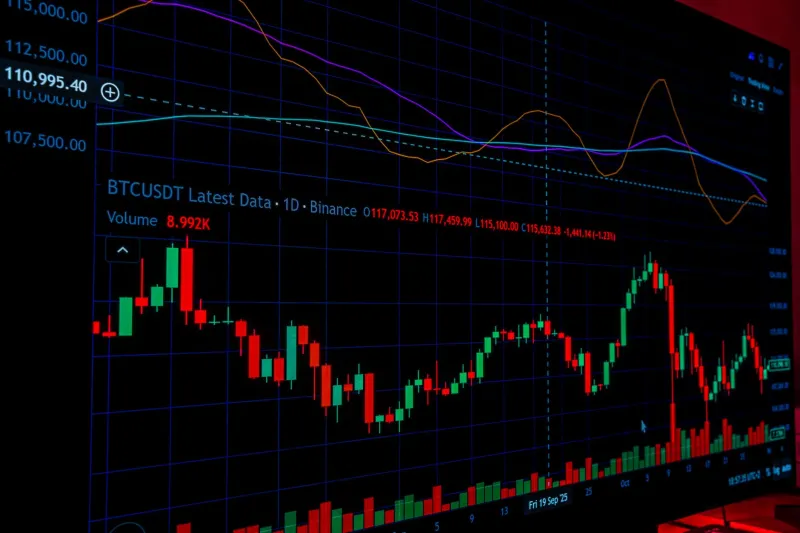
Brace for Impact: A US Investor's Tactical Playbook for Navigating the Next Crypto Downturn

Every seasoned crypto investor carries a scar or two from a correction they saw coming but failed to act on. The market gave signals. The data was there. Yet the gravitational pull of a bull run—the relentless green candles, the social media euphoria, the portfolio gains that felt permanent—made it nearly impossible to step back and prepare. The next correction will be no different. What separates investors who weather downturns from those who capitulate at the bottom is not luck. It is preparation.
This article is not a prediction. It is a framework. One built for US-based investors who want to remain active participants in the digital asset market—not passive victims of its volatility.
Reading the Warning Signs Before the Crowd Does
The most dangerous moment in any crypto cycle is when everything feels certain. That certainty, paradoxically, is often the first warning sign.
Volume Divergence is one of the earliest technical indicators worth monitoring. When an asset's price continues to climb but trading volume begins to decline, the rally is losing its foundation. Fewer market participants are willing to buy at elevated prices, and the upward momentum is increasingly driven by a shrinking pool of conviction buyers. On major exchanges, volume data is publicly available and worth reviewing weekly during extended bull phases.
Leverage Metrics tell an equally important story. Platforms that report open interest data—the total value of outstanding futures and perpetual swap contracts—can reveal when the market is dangerously overleveraged. When open interest reaches historically elevated levels relative to spot market capitalization, even a modest price dip can trigger cascading liquidations that accelerate a correction far beyond what fundamentals would justify. Tools like Coinglass provide this data in near real-time and are accessible to retail investors without a Bloomberg terminal.
Sentiment Indicators round out the early warning picture. The Crypto Fear & Greed Index, while imperfect, captures the aggregate mood of the market. Sustained readings above 80—deep into "Extreme Greed" territory—have historically preceded significant pullbacks. Similarly, when mainstream financial media outlets begin running breathless headlines about Bitcoin millionaires and altcoin riches, the cycle is often closer to its end than its beginning. This is not cynicism. It is pattern recognition.
Building a Defensive Position Without Abandoning the Market
The instinct to move entirely into cash during a correction is understandable but strategically flawed. For US investors, a full exit creates immediate taxable events, forfeits potential recovery gains, and leaves capital sitting idle during what could be the most attractive re-entry window in years. A more disciplined approach involves repositioning within the digital asset ecosystem rather than fleeing it.
Stablecoin Allocation is the most direct tool available. Gradually shifting a portion of a portfolio into USD-pegged assets like USDC or USDT does not require predicting the exact top. Instead, investors can implement a rules-based approach: if the Fear & Greed Index exceeds a predetermined threshold for five consecutive days, allocate an additional 10% to stablecoins. This mechanical discipline removes emotion from the decision and creates dry powder for future deployment.
Correlation Hedging is a more sophisticated strategy that many retail investors overlook. During severe market downturns, the correlation between Bitcoin and most altcoins approaches 1.0—meaning nearly everything falls together. However, certain assets have historically demonstrated lower correlation with BTC during stress periods, including select real-world asset (RWA) tokens and some DeFi protocols with revenue-generating mechanics. Diversifying across genuinely uncorrelated assets—rather than simply holding more tokens—can meaningfully reduce portfolio drawdown.
For investors with access to derivatives, inverse perpetual contracts or put options on major exchanges can serve as a hedge without requiring a full liquidation of long positions. This approach carries its own risks and is best suited to investors who have taken time to understand the mechanics of leveraged instruments before deploying them under pressure.
Strategic Rebalancing: Timing the Defense, Not the Bottom
One of the most actionable concepts for pre-correction positioning is the rebalancing window—a predetermined schedule or trigger point at which a portfolio is reset to its target allocation. Rather than attempting to call the top, investors establish rules in advance.
For example: if Bitcoin's dominance index rises above 58% while total market capitalization stagnates, rebalance the portfolio to increase BTC weighting and reduce exposure to smaller-cap altcoins, which typically suffer disproportionately during corrections. This is not market timing in the traditional sense. It is structured risk management.
Similarly, dollar-cost averaging out—the inverse of the popular DCA-in strategy—involves selling a fixed percentage of holdings at regular intervals during periods of elevated risk. A US investor might sell 5% of their altcoin exposure every two weeks when sentiment indicators remain in extreme greed territory, locking in gains incrementally rather than attempting a single well-timed exit.
What to Do When the Correction Actually Arrives
Despite best efforts, corrections often arrive faster and more severely than anticipated. The investor who has pre-positioned is still going to feel the discomfort of watching portfolio values decline. The key is to have a written plan—not a mental one—that governs behavior during the drawdown.
That plan should specify: at what price levels or percentage declines you will begin redeploying stablecoin reserves, which assets represent your highest-conviction long-term holdings that you will not sell regardless of short-term price action, and what your maximum acceptable drawdown is before you reassess the entire thesis.
Documenting these decisions in advance is not a trivial exercise. It is the difference between strategic action and panic-driven reaction.
The Long View
Corrections are not the enemy of crypto investors. They are, in many respects, the mechanism through which the most significant long-term gains are made available. The investors who positioned defensively before the 2022 bear market and redeployed capital near cycle lows generated returns that made the preceding bull run look modest by comparison.
At NugenCoin HQ, the philosophy is straightforward: the market rewards those who prepare, not those who react. Understanding the signals, building the defenses, and maintaining the discipline to execute a plan under pressure are the defining characteristics of an investor who doesn't just survive the next correction—but profits from it.
The data is available. The tools exist. The only remaining question is whether you will use them before the market forces your hand.